

How to Rob a Bank: the getaway is just the beginning
In David Leitch’s How to Rob a Bank, a crew of masked robbers livestreams every score — and a generation’s frustration becomes the real getaway car.
Directed by David Leitch • Written by Mark Bianculli • Rated R
For decades, the heist movie has followed a reliable playbook: assemble the crew, plan the job, vanish without a trace. How to Rob a Bank opens with the same irresistible setup and then tears up the rulebook. Here, the getaway isn’t the end of the story. It’s the beginning. Every robbery is filmed, edited and uploaded, turning a masked crew into internet celebrities whose audience grows with every crime.
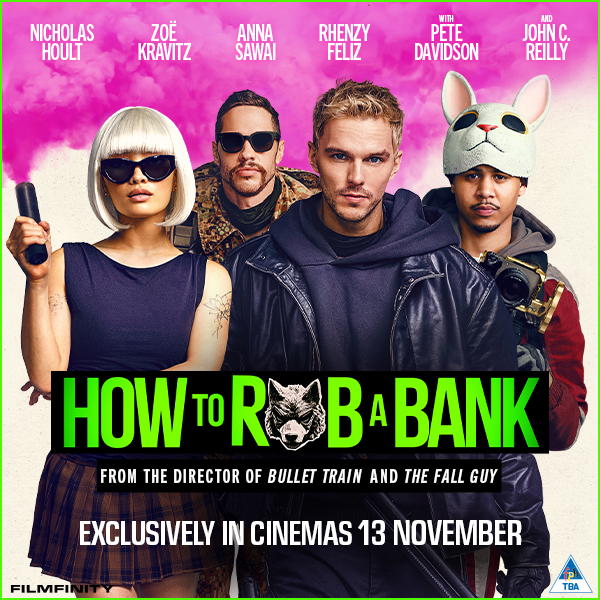
Directed by David Leitch (John Wick, Bullet Train, The Fall Guy) and arriving in theaters nationwide on November 13 from Amazon MGM Studios and Imagine Entertainment, the film stars Nicholas Hoult, Zoë Kravitz, Anna Sawai, Rhenzy Feliz and Pete Davidson, with John C. Reilly and Christian Slater. It follows a crew of social media-savvy bank robbers who broadcast their daring heists, unaware that their viral fame has put them in the crosshairs of a veteran FBI agent and a brilliant software engineer.
A QUESTION BEFORE A CRIME
The idea began with two unlikely sparks, according to screenwriter Mark Bianculli: an online video of thieves stealing an ATM in about a minute with a truck and a cable, and an FBI statistic showing that most first-time bank robbers actually make it out with the money. The question that followed became the engine of his script.
“If the barrier to entry is so much lower than most people imagine, what would it take to convince you to cross that line?”
Mark Bianculli, writer
Social media gave the story its edge. In Bianculli’s screenplay the internet isn’t a backdrop; it’s another member of the crew, as essential as a getaway car. At Imagine, producers Brian Grazer, Allan Mandelbaum and Jeb Brody saw something larger than a clever genre exercise: a thriller speaking to a generation told to chase the American Dream, only to graduate with enormous debt and a system that makes it hard to get ahead.
That emotional foundation is what separates the film from its premise. The scores deliver the thrills, but the people behind the masks supply the reason to care. Brody puts it plainly: the film begins with cops and robbers, and by the end, you start questioning who’s right, who’s wrong and who’s good.
LEITCH PLUGS IT INTO AN AMPLIFIER
Leitch and his producing partner Kelly McCormick, co-founders of 87North, found the script impossible to shake. McCormick recalls telling Leitch a week after reading it that she couldn’t stop thinking about it, and he felt the same. For Leitch, the appeal wasn’t how to rob a bank; it was what it means when robbing one starts to sound like a reasonable plan.
Bianculli says the director pushed for collision, and not only the physical kind: every character pushing against someone else, every set piece earned. His summary is memorable. Leitch, he jokes, took the script, plugged it into an amplifier and played the electric version.
THE CREW AND THE CHASE
At the center is Hoult’s Ryan, known online as “The Wolf,” a larger-than-life internet persona over a quietly grieving everyman. Leitch calls Hoult the first choice, praising his mix of charisma and vulnerability. Sawai plays Emi, the crew’s getaway driver and, in her own words, the brain of the group. She trained with stunt coordinator Greg Rementer until she had mastered a 180-degree turn.
Davidson plays Vince, a military veteran and father who served his country and is now robbing from it. Leitch promised the comedian he wouldn’t be asked for a single joke, and Hoult calls Davidson the emotional core of the movie. Feliz rounds out the crew as Hugo, the gifted editor who controls the group’s messaging and image.
On the other side, Reilly’s FBI agent John West comes from what the actor calls an analog world, and sees himself as the thin blue line between civilization and anarchy. To understand a crew that communicates in viral videos, he turns to Kravitz’s Reagan Gardner, a coder serving house arrest. Christian Slater, a familiar face from characters who challenged authority, plays David Walton, the arrogant CEO of Vitality Trust, the institution that becomes an early target.
TWO WORLDS, TWO LOOKS
The film’s visual design deliberately sets two languages against each other. Leitch and cinematographer Jonathan Sela shot much of the dramatic story on 16mm film, drawing on counterculture classics such as Badlands and Dog Day Afternoon, for texture and grit. When the robberies begin, the movie switches gears. A dedicated “YouTube unit” captured the heists from the crew’s perspective with compact cameras, drones and 360 cameras.
“The drama of our characters’ real lives is on film, and it’s juxtaposed with this flat, wild shooting style of the prosumer cameras.”
Kelly McCormick, producer
Production designer David Scheunemann set out to create an “American fairy tale,” a commentary on big money and big tech. The Vitality Trust building blends the Gulf Tower exterior with interiors shot at the Carnegie Museum of Art, layering new-money minimalism into historic spaces, “basically a blend between a bank and a tech company.” Graffiti spreads across the city as the movement grows, becoming a major part of the imagery by the finale.
The masks carry their own meaning. McCormick says the filmmakers wanted characters who felt vulnerable and closer to kids than adults, which is why the crew wears furry, stuffed-animal faces: a wolf, a rabbit, a bear. The Wolf also has a personal backstory. The Big Bad Wolf is Ryan’s son’s favorite book, an image Leitch weaves through the film, including looming over Ryan during his confessional.
PITTSBURGH PLAYS ITSELF
The film was not always set in Pittsburgh. Like many productions, it was first expected to land wherever logistics and tax incentives dictated. But after scouting, Leitch and McCormick fought to make the Steel City its home, and rather than disguise it as somewhere else, they embraced it: the yellow Sixth Street Bridge in the opening image, local sandwich shops, the Steelers’ colors. Reilly, who filmed Hoffa there more than two decades ago, was struck by how much the city has revitalized.
The city’s spirit showed up on set, too. The riot sequence demanded two weeks of overnight shooting with hundreds of extras, and McCormick says they all kept coming back the next day. “That’s Pittsburgh,” she says.
NO EASY ANSWERS
For all its spectacle, the filmmakers are wary of handing audiences a verdict. Ryan and his crew are neither folk heroes nor cautionary tales. Leitch says his job isn’t to tell people what to think, and if viewers are debating the choices on the drive home, the film has done its work. Grazer is more succinct: the movie entertains first, and only then does it speak to something people genuinely care about.
Beneath the robberies and the escapes lies something simpler. A group of collaborators in a criminal enterprise discovers an unexpected sense of belonging along the way. “They become less like a crew and more like a found family,” Leitch says, and that, he adds, is ultimately what the movie is about: people searching for connection and discovering that community may be the most valuable thing they can build.
How to Rob a Bank opens in theaters nationwide on November 13. Rated R for language, some violence and brief drug use. #HowToRobABank
How to Rob a Bank is in cinemas from 13 November. Book at Ster-Kinekor or Nu Metro.

The FundiConnect Editorial Team researches, writes, and maintains comprehensive guides on South African higher education, bursaries, NSFAS funding, and career development. Our content is verified against official institutional sources, DHET publications, and direct admissions office communications to ensure accuracy for students navigating their post-school journey.
Prefer FundiConnect on Google
Add us as a preferred source and see more of our guides in your Search results.

Bank on Capitec for a better life after matric
The dream of furthering your studies after matric can feel out of reach. Tuition fees, course costs and other educational expenses keep rising each year, and finding a way to pay for them isn't always easy.

Iwisa No.1 turns 70 – and hands the canvas to South Africa's boldest young designers
It's bolder. It's bigger. It's dripping with culture. As Iwisa No.1 marks 70 years of filling South African homes, its Fills Bold Designer Search returns for 2026 – bigger and better than ever – asking the country's boldest young creatives to help fill the brand's next 70 years. The winning designer is set to dress the brand itself, and every prize puts real tools in young creatives' hands.

Study Teaching with SANTS
There is a moment every great teacher remembers. The moment a child’s face lights…